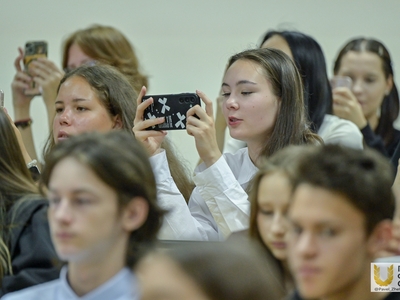
Students at Volga Region University learned more about the difficult life of Tatar poet Musa Jalil by visiting his apartment museum. The university also held a master class, "A Literary Encounter with the Poet," which allowed them to gain insight not only into his art but also into his personality.
"The tour will be a long-lasting memory for me—it's wonderful that in our time we can immerse ourselves in the everyday life of a poet from the past and experience it firsthand. We listened to breathtaking stories. Now, for us, Musa Jalil is not just a textbook hero, but a real person, a loving family man and a hard-working poet," said Elvina Sagadeeva, a first-year student at the Institute of Sports.
The event was organized by the university's Department of Foreign Languages and Linguistics to celebrate International Mother Language Day and the 120th anniversary of Musa Jalil's birth. The students were accompanied by Department Head Zoya Pavitskaya and Associate Professors Landysh Akhmetshina, Albina Shamsutdinova, and Aliya Garipova.
"This was our first time visiting the Musa Jalil Museum with the students, but we hold tours of the Gabdulla Tukay Museum every year. I believe these good traditions should definitely be continued next year," Zoya Pavitskaya emphasized.
The students were shown around the exhibition rooms and told interesting facts about the poet's biography, including a special focus on his wartime activities and a display of the famous Moabit notebooks.
"Poems written within the prison walls aren't just works of art, but the cry of a person's soul who continues to fight, no matter what," said Laysan Rashitova, a first-year student at the Institute of Sports, following the tour. "Today we learned a lot about the poet: he enjoyed chess and played musical instruments. We read a postcard he sent to his daughter when he was leaving for the front. Looking at these lines, you understand how difficult it was for him to leave his home and family. After such events, we are left with the feeling that we have touched something important, the history of our country."
Text: Adelina Khramova