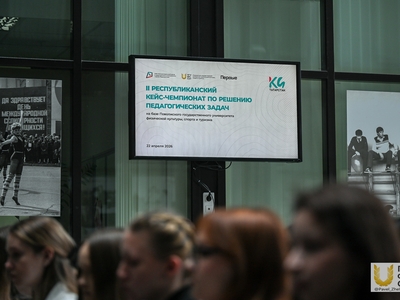
The annual budget of the Volga sports Academy is 1.5 billion rubles. Half of this money the University earns independently, and compared to 2011, the income increased 18 times. This is the result of effective use of the Universiade 2013 heritage-the self — sufficiency of the University facilities in 2018 amounted to 67%. The rector of the University Yusup Yakubov told about how the Academy manages to earn money at the Sport Connect forum. Here is a brief version of the speech.
TO EARN, TO GROW
The venue of the international forum Sport Connect (co-organized by the editorial office of "BUSINESS Online") was the Volga region Academy of sports, which brought together representatives of the sports community from four countries in Kazan. 13 speakers presented successful marketing solutions from the practice of club teams and the Finnish city of Lahti known for its sporting events.
The Academy itself stood out. Its rector Yusup Yakubov showed by examples that the creation and development of the University is a true marketing move of the state scale. In his speech at the forum, he spoke about the budget of the institution, the profitability of its sports facilities and sources of income: "a Sports University in Russia is an element of the state system, a budgetary institution. Our main task is to train specialists, coaches, highly qualified athletes. At the same time, to develop, we must earn — began his speech at the forum Yakubov. - A lot or a little, but the annual budget of the Academy is now 1.5 billion rubles. It allows the Volga region Academy of sports to occupy the first place in the ranking of physical education institutions of Russia in terms of content indicators".
On the part of the Volga region Academy seems to be successful, primarily due to its infrastructure — the legacy of the Universiade 2013, but in the world sports practice there are many examples when the legacy of major international sports events, up to the Olympic games, was not just inefficiently used, but was completely abandoned. A textbook example is the abandoned bobsleigh track of the 1984 Olympic games in Sarajevo. The Olympic Park in Beijing has become a thicket. The Olympic village in Turin has not found its application. Many objects of the Olympic Rio began to fall apart during the tournament. The participant of that Olympic games as a part of the national team of Russia and the student of the Volga region Academy Aleksander Krasnykh, for example, spoke about the Olympic pool: "Honestly, I expected something grandiose, but if we talk about the atmosphere, then, except the Olympic rings, I saw nothing in the pool. Not have the feeling of the holiday," said Red.
The objects of the Kazan Universiade run by the Volga region Academy do not experience such problems. But their operation, according to the rector, requires enormous costs. "We do a lot to maintain our huge infrastructure. When we started, the number of students was small (200 — in the first set of 2011), and it allowed to actively develop mass sports. Opened objects to people. We created the Institute of sports instructors and coaches, who were hired to work on a paid basis," Yakubov said.
"On the part of the Volga region Academy seems to be successful, primarily due to its infrastructure-the legacy of the Universiade 2013»
Since 2018, more than 3 thousand students from 72 regions of Russia and 14 foreign countries study at the Volga region Academy. For 7 regions (Bashkortostan, Udmurtia, Chuvashia, Kirov, Samara, Nizhny Novgorod and Ulyanovsk regions) the Academy has become a basic University for training specialists in the field of physical culture and sports. But, while the number of students grew, the Universiade facilities were not empty, but filled with a mass consumer. Students are now much more. For example, only one of the objects of the Academy — pool "Petrel" — compared to last year halved the time for mass sports. 80% of the time of the object is now occupied by students. In parallel, the sports facilities need to earn, expanding the range of market services and attracting citizens, including a variety of sports events.
According to Yakubov, more than 7 thousand children are now engaged in the Academy's facilities, the best of which are selected and continue training in 7 sports schools located at the sports facilities of the University. The rest are engaged in paid. "Our facilities host a lot of competitions of different, including international, level. Each object is aimed at expanding the market of services. The same "Petrel" holds swimming tournaments among veterans and children, the organizers of which are Olympic Champions Denis Pimankov and Evgeniy Korotyshkin. Next week Alexander Popov will hold 6 competitions with participation of Olympic Champions in different sports at our facilities within the framework of the Cup of his name," the rector said.
54% of the income of the Volga region Academy receives from sports events and commercial tournaments, which are organized and held at its base.
THE SELF-SUFFICIENCY OF OBJECTS
At the same time, the Academy helps students to monetize their skills at the learning stage. "We keep the sports specifics of the facilities, because they are our production base. Here we set the career path for the Academy students. Our student should not fall out of the sports process to become a qualified specialist after graduation. He or he already trains, or plays in club or student's sports team, participates in competitions of different level, receives qualification of the judge, organizes tournaments. We encourage this in every way, " Yakubov says.
The rector shared with the audience of the forum and some economic indicators. Like any state University, the Volga region Academy annually receives money from the Federal budget for the implementation of the state task. However, despite the increase in the number of students, this amount has not changed since 2013 and is 500 million rubles. In addition, the University pays 435 million rubles to various levels of the budget as a taxpayer. The Academy has to earn more than 50% of its budget on its own. "This is the result of an integrated approach that we apply in the development of the Volga region Academy," Yakubov says.
If in 2011 the University earned 38 million rubles, in 2018 this amount increased by 18 times. It's all about expanding the range of services provided. "Today, our non-sporting areas of work are profitable: educational services, residential complex, food plant. This allows us to maintain the sports infrastructure. In 2018, the self-sufficiency of our sports facilities will be 67 percent. This is a high figure for sports facilities in Russia as a whole and especially for the University infrastructure," Yakubov says.
Another source of income for the Academy is partnership with other organizers of projects of national and Federal importance. For example, such companies and organizations as Sberbank, Gazprom, RZD, ballet TODES, Igor Krutoy Academy and others hold creative and corporate events at the facilities of this University, investing their money in them. "This year alone, including Moscow and St. Petersburg, representatives of 29 regions of the country held events at our base. Their participants were about 200 thousand people. It is troublesome, but interesting for us," Yakubov said.
Of course, such events allow not only to earn, but also to give the opportunity to improve the skills of employees, to keep in good shape the teams working at the facilities. Another factor in the benefits of such large — scale events is increasing awareness and popularity for the Volga Academy itself, and this is a completely different level of status and influence. Finished his speech Yakubov, calling another serious figure: "We are becoming the center of attraction of a variety of people. According to preliminary estimates, 1.5 million people visited the facilities of the Volga region sports Academy this year alone. The whole of Kazan visited the facilities of the Volga Academy. More than once."
Share your opinion here: https://www.business-gazeta.ru/article/404239
Read more
06/23/2026 - 15:35
06/08/2026 - 12:03
05/13/2026 - 13:26