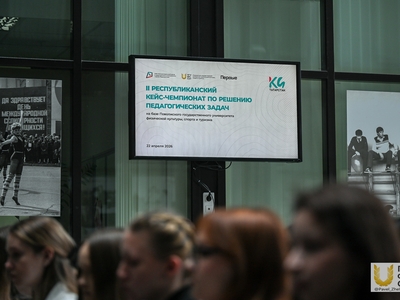
The international summer school of sports management and Economics, organized jointly by the Volga region Academy and the University, has ended. Friedrich Schiller (Jena, Germany) with the financial support of the German academic exchange service (DAAD).
Summer school is two weeks of full immersion in the world of big sports and big money. These are lectures, practical classes, preparation of presentations on given topics, excursions to sports facilities in a non-stop mode. Leading German experts in the field of sports Economics, management and marketing: head of the Department of sports Economics and health Economics at Jena University Professor Frank Daumann, head of the Department of Professional Services ("Professional services"), Professor of management in the field of sports and health at the University of Potsdam Christoph and head of the training program Master of Sport Management ("master of sports management") of Heidelberg University of applied Sciences, Professor of sports management and management Marcus Breuer. Live response received from the students of the school and performances of domestic experts, successfully using theoretical knowledge in practice. For example, the founder of the project "Timerman" Vadim Yangirov told the audience about the organization of "Kazan marathon".
The curator of the project from the Volga region Academy, Vice-rector for academic Affairs Almaz Galimov summed up the results of the summer school:
- The goals that we set for ourselves, for the first time entering into such a project, have been achieved. We have gained experience in organizing educational activities under the grant program at the international level and the opportunity to enter the market of projects with international participation. We took the chance to show our potential partners that we can count on the organization of such events at the highest level. This applies to the educational process, educational, entertainment and excursion programs. We managed to attract students from three countries and 11 cities of Russia. The German side was very pleased, our partners expressed interest in continuing cooperation. Therefore, we hope that next time we will be able to participate not only in the organization of the educational process, but also in the formation of its content. In particular, we hope that the lectures of German lecturers will be more focused on the practical component of the sports economy. Knowledge of the basics of sports management and marketing, our students get enough and in domestic universities... In addition, judging by the results of the survey conducted by us after graduation, the audience liked the performances of local speakers. Therefore, we intend to offer our German partners more active involvement of our experts. Another important point for us is that among the students of the school there were many young talented professionals from other regions. The fact that they have sacrificed summer time for training speaks about their active life position, ambitions and desire to develop. We hope that some of them after getting acquainted with the Academy and its capabilities will want to continue their scientific and professional career in the Volga region Academy. As for the excursion program, we received a positive response, as soon as the project started. Frank Daumann, who lectured first, in the first days gave the coordinator of the project in Germany an amazing review about the level of organization.
Professor Daumann himself is sure, as well as Almaz Galimov, that students will find application to the obtained knowledge, despite the fact that life in Germany and Russia is very different:
- We did not take into account the differences in the economies of our countries in our lectures. But the tools we use are universal. They are the same in Russia and Germany. Everywhere people react to stimuli. There may be differences in the context in which the response may differ. But something in common can be found. I believe that Russia has a free market.
According to its Executive Director, associate Professor of the Department of sports management, recreation and sports tourism of the Volga region Academy Gulnaz Ageeva, the desire to bring the summer school as close as possible to life explains the innovations that brought "academicians" to its program:
- I was a participant of the previous school, which was held in Chelyabinsk. I can compare. Of course, the project does not stand still, it is developing, including with our help. On our initiative, this year the final certification with the protection of projects was introduced into the school program. And as for the theme, it is updated from year to year. This time the program included lectures on some aspects of world sport, which were not mentioned in previous years. We are talking about corruption, doping, sponsorship in sports - the hottest and most popular topics in recent years.
Professor Marcus Breuer spoke on hot topics with students. He noted in the conversation that the quality of the last school determines, among other things, the active response of students to the words of the lecturer:
- The specificity of this school is that the level of students is different. There are graduates, there are students, and the fact that they work together is a big plus for all. They can gain experience from each other. I am particularly pleased with the success of the current student enrollment. They are active, ask questions, participate in discussions, prepare well for classes. If they are given a task, make presentations on their own initiative. I was happy to perform in front of them!
And Professor Christoph Rache, speaking about his impressions of the visit to Kazan, focused on the infrastructure:
- I am impressed by the modern, relevant infrastructure of your University and the students who were very pleasant in communication and deeply involved in the work. I was also impressed by the way the educational process was organized: simultaneous translation, technical support of lectures. Everything is at the highest level. I am sure that such projects as this school are necessary. Russia and Germany need to maintain contacts in all areas, including at the level of cooperation between students and professors. We must develop together. Russian universities, it makes sense to join the program Erasmus (non-profit program of the European Union for the exchange of students and teachers between universities of EU member States, as well as Iceland, Liechtenstein, Macedonia, Norway, Turkey).
Read more
06/23/2026 - 15:35
06/08/2026 - 12:03
05/13/2026 - 13:26