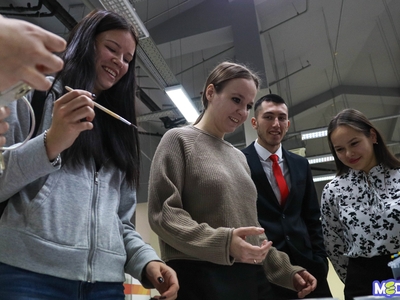
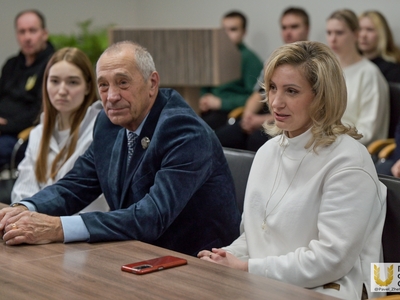
The second day of the 5th Annual All-Russian Scientific and Practical Conference "Kazan Sports Medicine Club" was no less productive than the first. Physicians and specialists in sports medicine and rehabilitation, along with representatives of federations, sports clubs, and research schools, gathered at Volga Region University to share cutting-edge knowledge.
The conference was a joint event between Kazan State Medical University and the University of Sport and Tourism, strengthening cooperation between the universities.
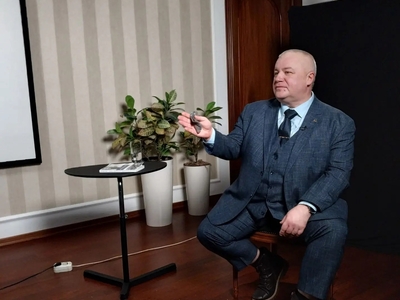
Andrey Nazarenko, Vice Rector for Research and International Affairs at Volga Region University, opened the second day's session, setting the tone for the discussion and wishing it success.
Representatives of the University of Sport also presented at the conference. Larisa Parfenova, Head of the Department of Adaptive Physical Education, discussed the phenomenon of sports-based interventions in the adaptive physical education of individuals with intellectual disabilities.
She presented the results of a ten-year study conducted by the department's staff aimed at substantiating a comprehensive approach to the motor activity of children with intellectual disabilities. Its core objective is to examine the relationship between sports and the development of not only physical but also mental and social skills in this category of children.
The study included an analysis of 157 dissertations, practical testing of children using GTO standards and psychological methods, as well as monitoring of children's physical education and sports activities and a sociological survey of 52 experts. This study established the positive impact of sports on children's health and well-being, while also identifying the contradiction between the demand for physical activity and the disparity in available sports.
In turn, Nailya Davletova, Professor of the Department of Medical and Biological Disciplines, presented a study aimed at studying the characteristics of physical activity in mature men and justifying the transition from competitive training to systematic, personalized health promotion.
The study identified and described the "false well-being syndrome," which manifests itself as a discrepancy between subjective age assessment and objective somatic status. The practical result was the development of a "digital prescription" concept that will allow medical professionals to regulate, dose, and monitor patients' physical activity using modern IT solutions.
"The conference featured a professional discussion. Particular attention was paid to barriers to patient adherence to therapy and the implementation of digital solutions in sports medicine for the subsequent adaptation of scientific hypotheses to real-world clinical practice. This allowed us to share best practices with colleagues," emphasized Nailya Davletova.
Text: Adelina Khramova
Photo: Pavel Zheleznyak