The Department of Gymnastics Theory and Methodology, within the framework of the cooperation agreement with the Russian Gymnastics Federation, prepared a project that resulted in neurogymnastics and coordination training complexes that can be performed to increase overall productivity, develop cognitive abilities and improve health.
Among the tasks of the project implementation is to introduce neurogymnastics and coordination training to the participants of the World Youth Festival junior shift, to teach them how to assess their cognitive abilities and to teach them how to create complexes of neurogymnastics and coordination training exercises depending on the specific type of activity.
A total of 76 thousand applications from children from 14 to 17 years old were submitted for the junior shift, of which 1000 applications were selected. 500 of them represented Russia, and the other 500 represented foreign countries.
The junior shift "Let's Start the Future Together" was represented by a large number of countries, so the project required the participation of two teachers - Lyubov Botova, Head of the Department of Gymnastics Theory and Methodology, was assisted in the implementation of the project by Alexander Sychugov, European Champion, Master of Sports International Class in artistic gymnastics.
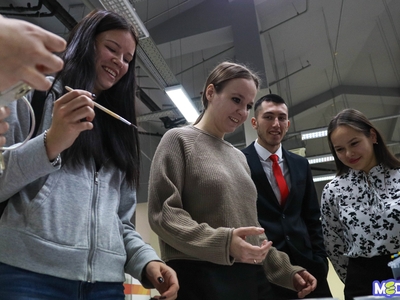
"The concept of the junior shift is very interesting - there is a serious educational programme involving leading experts from the fields of sport, science and art. For example, Yuri Gagarin's workshop is for children interested in space, and Sofia Kovalevskaya's workshop is for those interested in maths. Valery Kharlamov's workshop was dedicated to sports and healthy lifestyle - here we helped 65 children to create projects in the field of sports," says Lyubov Botova. - There were six labs in our workshop, with 10-12 people in each. The children chose the labs on their own when they got acquainted with the project passports a week before the festival. In our "class" there were 11 children from Russia, Jordan, Syria, Kazakhstan, Azerbaijan and Tajikistan. In five days we learnt about types of gymnastics, got acquainted with neurogymnastics and elements of coordination training, and developed sets of exercises for use in everyday life, education and sports.
I think the experience of using coordination training tools will be very useful for children, for example, before the start of the school day to stimulate cognitive activity. For example, the simultaneous execution of movements with both hands, as in one of our complexes, allows for the harmonious development of brain structures and their harmonious interaction. Such movements can help to improve memorisation, which is very necessary for both adults and children.
It was nice to see how during the work with the children, after three days, they were able to do better the exercises that they were not able to do at the beginning. This shows the brain's plasticity, learning and coordination abilities - something that is so important to develop in our children.
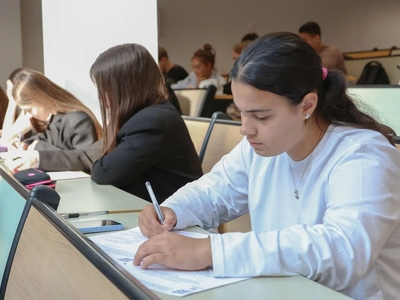
There was also a scientific component to the preparation of the project. The children learnt to work with Schulte tables - they determined performance and concentration, as well as mental stability and speed of production. In parallel, we evaluated control exercises related to coordination abilities.
At the project festival, which was the outcome of the training, the children themselves taught the learnt exercises with their hands, exercises with balls, as well as explained how to handle a neuroskipping rope and conquer a balance board with a maze. We almost didn't get to the festival itself, but we didn't miss the dance show where our teachers Olga Sbitneva and Ivan Yudin performed. In general, our participation in the World Youth Festival can be characterised as a difficult but very interesting experience, which allows us to look at many things from a different angle".
Text: Daria Bezzubova