The "Healthy Environment" initiative at the Volga Region University—a program dedicated to the holistic development of students—featured a packed schedule of educational and awareness-raising activities during the first month of the academic year. First and foremost, new students were briefed on online safety protocols and introduced to the fundamentals of critical thinking to help them avoid falling victim to scammers.
For instance, first-year college students participated in a "forum theater" session titled "Conflict in the Student Community: Managing and Acting." The session was led by Ekaterina Busova, a senior psychologist at the Main Directorate of the Russian Emergencies Ministry (EMERCOM) for the Republic of Tatarstan.
The event focused on teaching students how to recognize and counter manipulation. Participants explored the concept of manipulation and its various components, including common manipulative tactics and guidelines for safe behavior. The session also addressed the art of refusal, equipping students with effective ways to say "no" to those attempting to exploit them.
Furthermore, the speaker emphasized the importance of relying solely on verified information sources: "You need to be able to distinguish between facts and interpretations. When reading the news, it is essential to look only to official media outlets."
During the session, students analyzed and discussed various case studies, proposing the best courses of action for specific scenarios—specifically, how to resist a manipulator's influence. At the end of the lecture, they noted how much they had learned: "You might think you know how to react, but in the heat of the moment, you often forget. That’s why hearing an expert’s advice was so valuable."
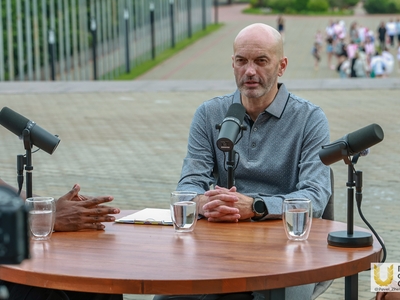
Arslan Mingaliev, an expert from the KFU Coordination Center for Countering Terrorism and Preventing Extremism, conducted a lecture and discussion titled "Extremism Among Youth: Boundaries, Risks, and Responsibility" for the university's first-year students. He presented examples of how malicious actors recruit people of all ages and explained how to conduct oneself to avoid becoming part of the schemes devised by terrorists and extremists.
The students learned about safety measures designed to help them protect their personal data, avoid falling victim to harassment and misinformation, and steer clear of radicalism and destructive movements.
In conclusion, Arslan Mingaliev emphasized that the primary danger of terrorist activity lies in undermining societal security—ensuring that news of attacks is heard everywhere, particularly in the media—thereby heightening widespread anxiety and a sense of isolation.
– The main goal of the meeting is, first of all, to talk about the fact that safety among youth is not something distant in the news that does not concern us, but what is happening next to us here and now. And it is in our hands to make sure that this security is as strong and effective as possible. I would like students to really understand this.
There is no need to try too hard to save the whole world. You will most likely overstrain yourself. But you don’t need to be indifferent, because this cold kills any connections between people. It is important to form an adequate perception of responsibility and your rights,” concluded Arslan Mingaliev.
A training session for tutors was also held, led by Ksenia Krivova—an informal communication trainer at the university’s Center for Socio-Psychological Monitoring of Deviant Behavior—and Alexander Zaybert, a lead consultant at the Ministry of Youth Affairs of the Republic of Tatarstan’s Department of Psychological Support and Prevention.
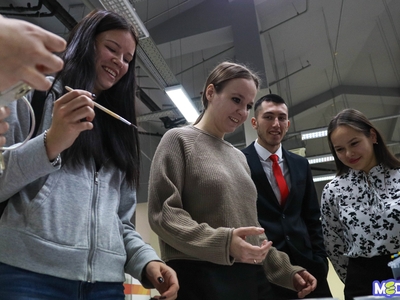
The event followed a "theory-to-practice" approach: the participants began by exploring the principles of healthy communication—skills the organizers noted would be valuable for interacting with their mentees as well as with senior mentors, such as faculty supervisors and instructors. The speakers also conducted two exercises to reinforce the new material, followed by team-building and ice-breaking activities. Participants shared information about themselves and created illustrations representing their personalities, thereby getting to know one another better.
"Be open, don’t be afraid to seek help from the specialists at the Center for Socio-Psychological Monitoring of Deviations when difficulties arise, and simply enjoy your work!" Ksenia Krivova said in her parting words to the tutors at the end of the training.
The "Healthy Environment" event concluded with a "Curator's Time" focus session, featuring educational activities for senior student group mentors. Highlights included a seminar titled "Shaping Students' Life-Meaning Orientations," led by Adelya Anisimova—head of the Psychological Support Department at the "Navigator" Republican Center for Youth, Innovation, and Prevention Programs (under the Ministry of Youth Affairs)—and a seminar on "Identifying Risk Signs of an Attack on an Educational Institution and the Curator's Response," conducted by the Center for Socio-Psychological Monitoring of Deviant Behavior.
The event wrapped up with a methodological meeting on "Informing Students About Voting Rights and Procedures," attended by Azaliya Abzalova, Head of the HR Division within the Legal Support and HR Department.
Text: Adelina Khramova / Elizaveta Vasalatiy
Photo: Kira Grudina